Olive Grove Conference: Results of the Biolivar Project and Progress towards a Sustainable Olive Grove
The XXIX Jornada del Olivar de Asaja-Sevilla, held at the headquarters of Oleoestepa with the collaboration of the Protected Designation of Origin (PDO) Estepa, was the setting for the dissemination of the results of the Biolivar Project. Since its inception in September 2022, this project has sought to boost sustainability in the olive sector through practices that promote biodiversity and reduce soil erosion. The conference was inaugurated by Jesús Juárez, president of Oleoestepa; Antonio Jesús Muñoz, mayor of Estepa; Manuel Gómez Galera, general secretary of Agriculture; and María Morales, president of Asaja-Sevilla. All of them highlighted the importance of an olive grove that is evolving towards a more sustainable and healthy model.
Andalusian Strategy and the Biolivar Project
During the conference, the Secretary General of Agriculture, Manuel Gómez Galera, presented the Andalusian Strategy for the Olive Sector 2023-2027, which seeks to improve the competitiveness and sustainability of olive farms. This strategic plan will promote organic production and the quality of olive oil through PDOs and PGIs, in addition to promoting the healthy consumption of olive oil, in line with the objectives of the Biolivar Project.
Progress and Achievements of the Biolivar Project
The Biolivar Project, coordinated by Asaja-Sevilla, has brought together key players such as CSIC, DOP Estepa, Evenor-Tech, the University of Cordoba and the University of Jaen, among others. This collaboration has been instrumental in developing innovative agricultural practices that not only protect the natural environment, but also improve farm profitability and the quality of life in rural areas.
Ground Covers for Soil Health and Biodiversity
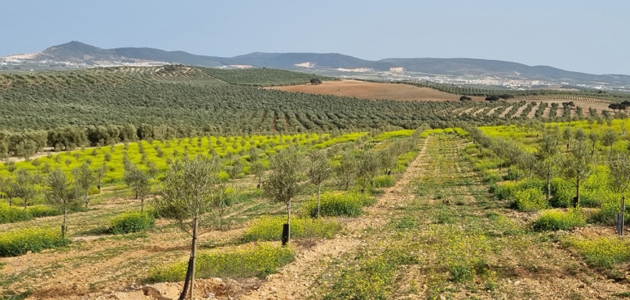
One of Biolivar’s outstanding achievements has been the implementation of vegetative covers in olive groves. José Alfonso Gómez, researcher at the Institute of Sustainable Agriculture (IAS-CSIC), explained that plant covers provide long-term agronomic benefits, such as erosion control and improved water retention in the soil. However, he warned of the need to balance these advantages with the risk of competition for water with olive trees, adapting the covers to the particularities of each farm. The project has produced a guide on vegetative covers that will guide farmers in their implementation, and a guide on olive grove erosion that offers recommendations to minimize this phenomenon.
Biodiversity in the Olive Grove: Ants and Birds as Ecological Indicators
The Doñana Biological Station (EBD-CSIC) has studied how biodiversity in olive groves is reflected in the presence of ants and birds. Xim Cerdà and Ramón Soriguer, researchers of the project, pointed out that ants and birds function as key indicators to evaluate the health of ecosystems in different farms (irrigated, rainfed and super-intensive). Ants, which are studied by sampling in traps, showed a higher diversity in irrigated farms. As for birds, Soriguer observed that diversity and abundance benefit more in systems that include several types of olive groves and crops, creating a “mosaic of habitats” favorable for a greater number of species.
Olive grove as a CO₂ sink
The potential of the olive grove to capture carbon dioxide was also highlighted during the day. Roberto García, professor at the University of Jaén, pointed out that olive groves can make a significant contribution to the European Union’s carbon neutrality by 2050. García explained that, through proper olive grove management that optimizes CO₂ capture, relevant climatic benefits can be obtained. Within the framework of Biolivar, a storage of up to 160 tons of CO₂ per hectare has been recorded in the permanent structures of the olive trees, a figure that, according to García, is equivalent to 300 times the CO₂ emitted by all the vehicles in the municipality of Estepa in a year.
Innovation and Sustainability Hand in Hand with Technology
Syngenta, through its sustainability manager, Francisco García, highlighted the importance of technological innovation to achieve sustainability in the olive grove. The company has worked on precision agriculture solutions, biostimulants and biocontrol, which optimize crop health and reduce environmental impact. With tools such as Cropwise, Syngenta facilitates decision making and helps farmers select products that are adapted to the specific conditions of each crop, improving profitability without compromising the environment.
García emphasized that agricultural sustainability depends increasingly on technology, which allows detailed knowledge of the soil and its relationship with the health and productivity of the olive grove. “We are exploring how innovation can improve soil health while increasing farm profitability,” he said.